NCCN 2024-2025
Clinical Pearls
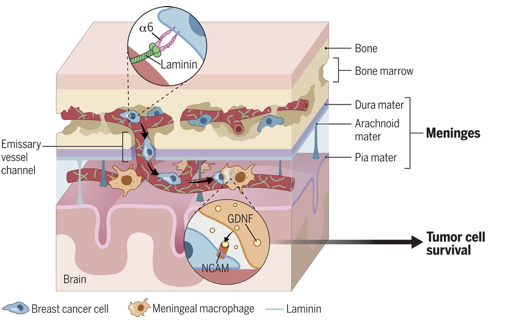
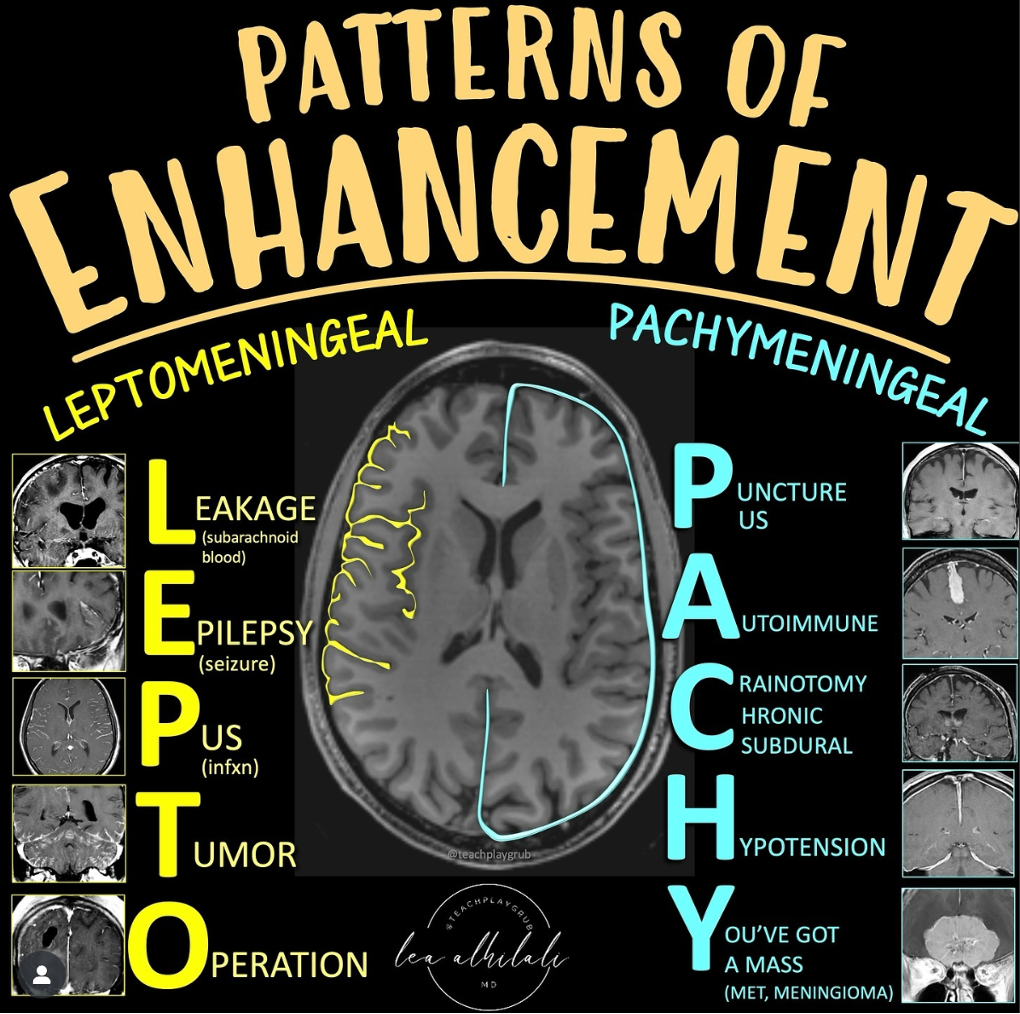
- Very aggressive B-cell NHL, complex, most rapidly proliferating human malignancy (Ki-67 ≥95%). Goal of therapy is cure. Usual extranodal involvement (bulky abdominal mass, BM ≤70%, leptomeningeal ≤30%). TLS (high-risk) due to rapid cell turnover.
- WHO classification: Endemic (most common childhood malignancy, equatorial Africa, mostly EBV+, same ttt), Sporadic (1-2% of all adult lymphomas, EBV+ [30%]), and Immunodeficiency-associated subtypes (HIV, congenital immunodeficiency, some HCT).
- Evaluation: PE, ECOG, B symptoms (fever, night chills, wt loss), CBC, CMP, LDH, uric acid, PET/CT, MRI brain (if neuro symptoms) LP, CSF flow cytometry, HIV, HBV, EBV, echo/MUGA (if anthracycline), pregnancy
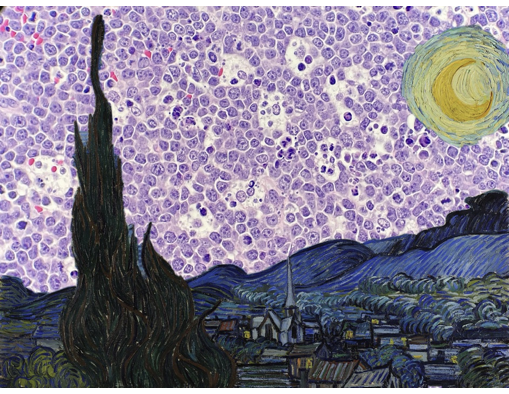
- Genomics/Genetics (CD10, CD19, CD20, CD22, BCL6): TdT-, BCL2-. MYC translocation (t[8;14] in 80%, t[8;22], t[2;8]); also in DLBCL, HGBL. Medium-sized, starry sky pattern morphology. If MYC- & 11q aberration, it is not BL but treated like it (it is LBCL/HGBL with 11q aberration).
- Etiology: Associated with EBV (especially in endemic cases).
- For Burkitt lymphoma (BL), the hallmark genetic event is a MYC translocation showing c-MYC overexpression (B looks like 8):
- t(8;14)(q24;q32) → MYC translocated to the immunoglobulin heavy chain (IGH) locus (≈80% of BL).
- t(8;22)(q24;q11) → MYC translocated to the immunoglobulin λ light chain (IGL) locus.
- t(2;8)(p12;q24) → MYC translocated to the immunoglobulin κ light chain (IGK) locus.
- Prognosis: Ki-67 ≥95% and LDH (prognostic factors). BL-IPI (age≥40, PS≥2, LDH>3×ULN, CNS involvement); low (3y PFS 92%, OS 96%), intermediate (72%, 76%), high (53%, 59%). 60-90% peds/young adult achieve durable remission.
- Poor prognosis: age ≥40, high LDH, ECOG ≥2, CNS involvement
- Management (regimens from pediatric protocols): intensive multiagentchemoimmunotherapy + systemic/IT CNS ppx. Rituximab improved survival. CODOX-M/IVAC and HyperCVAD showed improved OS and less CNS relapse. R-CHOP is INADEQUATE.
- German Study Group (short-intensive regimen [HD-MTX, HD-Ara-C, cyclophos, etopo, ifosfam, steroids] + rituximab): CR 88%, 7y PFS 71%, OS 80%. Triple IT prophylaxis (MTX + Ara-C + dexamethasone).
- French GELA Phase III (n=260; R + short-intensive chemo vs chemo alone): 3y EFS 75% vs 62% (P=0.024).
- Real-world analysis (n=641, rituximab): 3y PFS 67% vs 38%, 3y OS 72% vs 44%; P<0.001.
- Swedish/Danish registry (n=258; CODOX-M/IVAC vs HyperCVAD vs CHOP±etoposide): 2y OS 69% vs 83% 39%
- All regimens for BL should include CNS prophylaxis (MTX, AraC) due to leptomeningeal involvement. Patients presenting with symptomatic CNS disease should be started with the portion of the systemic therapy that contains CNS-penetrating drugs.
- Both IV+IT of MTX+AraC in CODOX-M/IVAC and HyperCVAD. Only MTX IT in DA-EPOCH-R, RICE, RGDP.
- IT doses: MTX (12mg, 15mg) and Cytarabine (50mg, 70mg, 100mg). May consider Ommaya reservoir placement.
- Management is based on risk and age (no head-to-head trials)
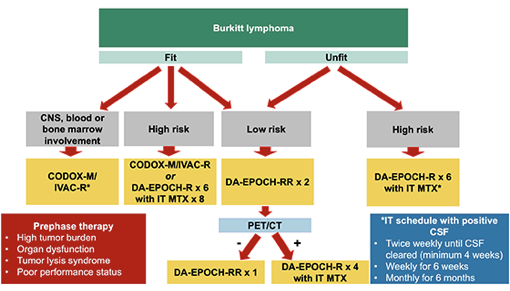
- Low risk BL (normal LDH, S1 [1 extra-abdominal mass <10cm], completed resected abdominal lesion): clinical trial or chemoimmunotherapy
| <60y | R-CODOX-M x3cycles R-HyperCVAD (if fit) DA-EPOCH-RR (leptomeningeal) x2 cycles then PET (if CR: +1 cycle; if PR: DA-EPOCH-R x4 cycles+IT MTX) |
| ≥60y | DA-EPOCH-RR (leptomeningeal) x2 cycles then PET (if CR: +1 cycle; if PR: DA-EPOCH-R x4 cycles+IT MTX) |
- High risk BL (S1 abdominal mass or extra-abdominal mass >10cm] or SII-IV): clinical trial, chemoimmunotherapy; +CNS ppx
| <60y | R-CODOX-M/R-IVAC x4 alternating cycles +systemic+IT CNS ppx (ITX, AraC) R-HyperCVAD alt w/ HDMTX+AraC (if fit) DA-EPOCH-R x6 cycles + IT MTX (less aggressive) |
| ≥60y | DA-EPOCH-R x6 cycles (less aggressive) + IT MTX (if symptomatic CNS disease) |
- R-CODOX-M/R-IVAC (aggressive therapy; low risk [without R-IVAC], high risk)
- Original (1998): 1-yr EFS ~85%. Too toxic for adults, hence, modified regimen was developed.
- Modified (+ rituximab, vincristine cap 2 mg, MTX reduced 7→3 g/m², shorter duration, earlier leucovorin, simpler IT): 2y OS ~70-73%, OS ~81-87% (low risk), OS ~60-70% (high risk); improves PFS/OS with Rituximab (3y PFS 74% vs 61%; OS 77% vs 66%).
- Phase II trial: High-risk + rituximab (IPI 3–5, some with CNS involvement): 2-yr PFS 77%, OS 81%.
- HyperCVAD alt w/ HDMTX+AraC + IT MTX CNS ppx (low risk, high risk)
- Long-term follow-up (BL, HGBL): effective in preventing CNS relapse especially in high-risk BL; CR ~91% (~96% BL), 5y OS ~55% BL, 5y RFS ~58%. Relapse (CIR) 21% (BL: 14%); higher if BM (27%) or CNS involvement (42%) at baseline. 5y CNS relapse 6% (4% BL); higher if CNS involvement at baseline (16%).
- DA-EPOCH-R (low risk, high risk; CNS negative disease; relapse >6-18mo)
- Avoid in CNS involvement. Sometimes used as risk-adapted DA-EPOCH-RR (rituximab given twice, on days 1, 5).
- Prospective study (low-risk bias; DA-EPOCH-R vs SC-EPOCH-RR): FFP 95%, OS 100%.
- Multicenter phase II (mostly high-risk, n=113; DA-EPOCH-RR): 4y EFS 85% (82% high-risk), 4y OS 87% (85% high-risk). CSF involvement showed worse outcomes (EFS 46% vs 90% no CSF involvement). BM/blood involvement also worsened EFS (67% vs 92%). CNS relapse very rare (2%).
- Phase III RCT (high-risk, no CNS involvement; DA-EPOCH-R vs R-CODOX-M/R-IVAC): 2y PFS 76% vs 70%. Trial stopped early (low accrual). DA-EPOCH-R had fewer infections (34% vs 56%).
- Response to above 1L therapy for low/high risk
- If <CR: clinical trial or palliative ISRT (if clinical trial not available)
- If CR: follow-up is individualized (below are options from NCCN)
- q6mo x1y then PRN as relapse after 1y is uncommon (relapse prognosis is poor)
- q2-3mo x1y then q3mo x1y then q6mo thereafter; relapse after 2y is rare
- Relapse/refractory BL: majority are not chemo-sensitive disease; better outcomes if R/R ≥6mo and chemosensitive disease.
- Relapse <6mo after 1L: clinical trial, best supportive care (including palliative ISRT)
- Relapse >6mo-18mo after 1L: clinical trial, 2L, best supportive care
- 2L (limited data): DA-EPOCH-R (leptomeningeal) x6 cycles + IT MTX (if not previously given), RICE, RIVAC, R-HIDAC, RGDP
- If CR: consider HDT/ASCR ±ISRT, consider alloHCT±ISRT (if SC mobilization failure or BM involvement persists)
- If PR: additional 2L, consider HDT/ASCR ±ISRT, consider alloHCT±ISRT (if SC mob. failure or BM involvement persists)
- If NR/DP: clinical trial, best supportive care + palliative ISRT
- Consolidation autoHCT is not recommended in remission after induction therapy due to comparable survival outcome in chemoimmunotherapy.
- Supportive Care Consideration
- G-CSF primary prophylaxis due to high-risk FN (CODOX-M/IVAC, HyperCVAD, DA-EPOCH-R): filgrastim SC 5mcg/kg/d 24-72h after chemo, pegfilgrastim SC 6mg once 24h after chemo (avoid if within 14d of next chemo)
- Infusion reaction (Rituximab): APAP, dexamethasone, diphenhydramine
- TLS Prophylaxis (high tumor burden, VERY HIGH risk): Hydration, allopurinol (low-intermediate risk), Rasburicase 3-6mg once (G6PD test; if uric acid >8mg/dL, bulky disease, PO intolerant). Monitor K, Phos, Ca.
- Cardiotoxicity (Doxorubicin): monitor LVEF by ECHO/MUGA at baseline, then when needed.
- Neuropathy (Vincristine, Cisplatin): dose reduction/interruption if severe.
- HSV prophylaxis (prolonged steroids): Acyclovir 400mg PO BID.
- PJP Prophylaxis (prolonged steroids): TMP-SMX or Dapsone.
- HBV/HCV reactivation (Rituximab): screening at baseline (sAg, HBc; eAg if high risk factor; viral load if positive and GI consult), treat when needed. Entecavir or Tenofovir ppx if receiving rituximab.
| Regimens | Medications |
| R-CODOX-M | Rituximab, Cyclophosphamide, vincristine (Oncovin), DOXorubicin, Methotrexate (high-dose) |
| R-CODOX-M/R-IVAC | Rituximab, Cyclophosphamide, vincristine (Oncovin), DOXorubicin, Methotrexate (high-dose) Alternating with Rituximab, Ifosfamide, Mesna (uroprotection), etoposide (Vepesid), cytarabine (high-dose Ara-C) CNS prophylaxis: Intrathecal MTX or Ara-C in every cycle. |
| R-HyperCVAD | Rituximab, Hyperfractionated (smaller doses but more frequent), Cyclophosphamide, Vincristine, doxorubicin (Adriamycin), Dexamethasone [+IT MTX +IT AraC] Alternating with rituximab, high-dose methotrexate and cytarabine [+IT MTX +IT AraC] |
| DA-R-EPOCH | Dose-Adjusted Rituximab, Etoposide, Prednisone, vincristine (Oncovin), Cyclophosphamide, doxorubicin (Hydroxydaunorubicin) [+IT MTX] |
| DA-EPOCH-RR | Dose-Adjusted Etoposide, Prednisone, Vincristine (Oncovin), Cyclophosphamide, Doxorubicin (Hydroxydaunorubicin), Rituximab, Rituximab |
| R-IVAC | Rituximab, Ifosfamide, Mesna (uroprotection), etoposide (Vepesid), cytarabine (high-dose Ara-C), |
| R-GDP | Rituximab, Gemcitabine, Dexamethasone, Platinum (carboplatin, cisplatin) [+IT MTX] |
| R-ICE | Rituximab, Ifosfamide, Carboplatin, Etoposide [+IT MTX] |
| R-HiDAC | Rituximab, High Dose Cytarabine (Ara-C) |