- Anticancer causative agent: HDACi (Belinostat, Panobinostat, Romidepsin, Vorinostat)
The CDC surveillance report estimates that 1.1 million persons are living with HIV in the United States. This includes the estimated 166,000 persons whose infection has not yet been diagnosed. There is support for HIV testing in all patients treated for cancer. Patients who are HIV-positive and have cancer are classified as having either AIDS-defining cancer (ADC) or non–AIDS-defining cancer (NADC). ADC includes Kaposi sarcoma, NHL, and cervical cancer. There is a higher incidence of these cancers in those who are HIV-positive than in those who are HIV-negative.
The incidence of NADC is increasing, likely due to the longer life expectancy of patients with HIV resulting from the advancement of treatment options. Patients with HIV and NADC were shown to have an overall worse cancer outcome when compared to patients who are HIV-negative with the same cancer. However, improvement in outcome was seen when patients with HIV received highly active antiretroviral therapy (HAART). There should be caution regarding the concomitant administration of select antiretroviral therapies (including the protease inhibitors and non-nucleoside reverse transcriptase inhibitors) with cancer therapy as adverse events through cytochrome P450 3A4 have been documented. A publication from MD Anderson Cancer Center retrospectively evaluated the use of HIV screening in patients prior to systemic cancer therapy. Out of the 18,874 patients in this study, there were 3514 patients who tested positive for HIV at the initiation of systemic cancer therapy. Patient histories indicated a higher incidence in patients with sexually transmitted disease (37.7% vs. 18.5%; P < .001) or a history of illegal drug use (46.2% vs. 18.6%; P < .001). Patients screened for HIV included 12.1% of patients with NADC and 9.4% of patients with cervical cancer. Interestingly, a significantly higher percentage (88.4%) of patients with NHL were screened for HIV, which may be partially attributed to clinician education of the role of HIV in these patients.
In 2006, the CDC published recommendations for routine HIV testing in all patients (13–64 years of age) in the health care setting.300 The testing is intended to be voluntary and conducted only with consent from patients. Under these guidelines, patients are informed either verbally or in written format that HIV testing will be conducted unless the patient declines testing (opt-out screening). The CDC recommends that patients at high risk for HIV infection be screened at least annually. The implementation of these guidelines is largely dependent upon institutional practices and the prevalence of undiagnosed HIV infections in specific institutions. However, the NCCN Panel strongly encourages concordance with the CDC recommendations.
In addition to the CDC recommendations, the NCCN Panel emphasizes that all patients receiving chemotherapy or IST be screened for HIV. Patients co-infected with hepatitis pose an additional complication. Select antiretroviral therapies including the integrase strand inhibitors and nucleoside/nucleotide reverse transcriptase inhibitors have demonstrated fewer drug-drug interactions compared with the protease inhibitors and non-nucleoside reverse transcriptase inhibitors. However, consultation with an infectious disease expert is necessary for treatment of HIV in patients with cancer as therapies continuously evolve. HIV viral load should be monitored monthly during therapy and then as clinically indicated (see Management Of Hepatitis B Virus, Hepatitis C Virus, And Human Immunodeficiency Virus Reactivation Or Disease in the algorithm and NCCN Guidelines for Cancer in People with HIV).
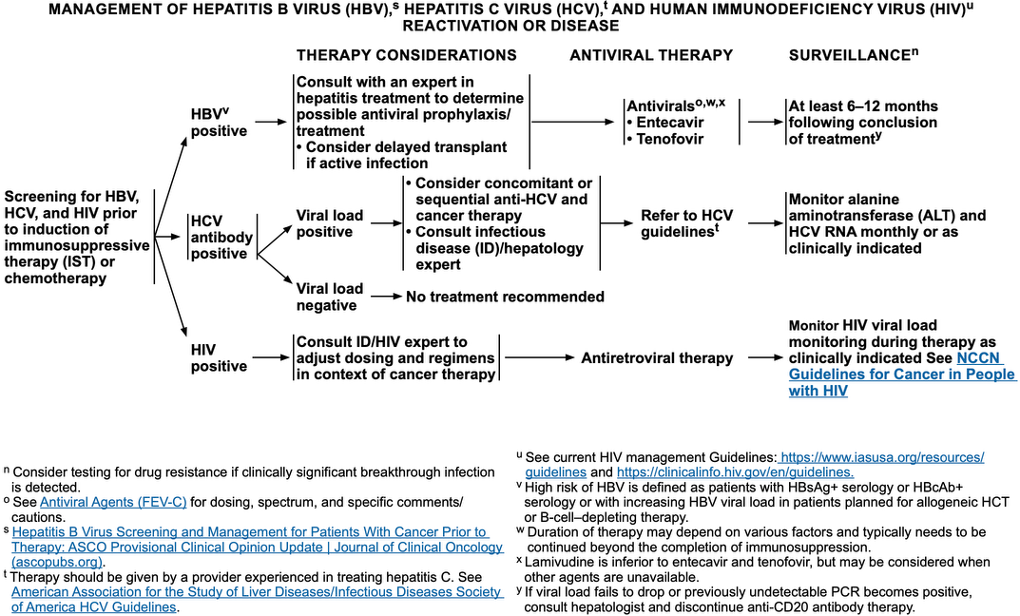
HIV+HBV
Treatment:
- Never use HBV monotherapy (lamivudine [3TC], emtricitabine [FTC]), it may lead to HBV resistance.
- Dual HBV-active backbone: Tenofovir (TDF or TAF) + (3TC or FTC); + INSTI (Bictegravir or Dolutegravir)
- If TDF can’t be used (renal/bone toxicity), may use TAF instead. If Tenofovir can’t be used, may use entecavir (ETV+DTG+ABC/3TC).